
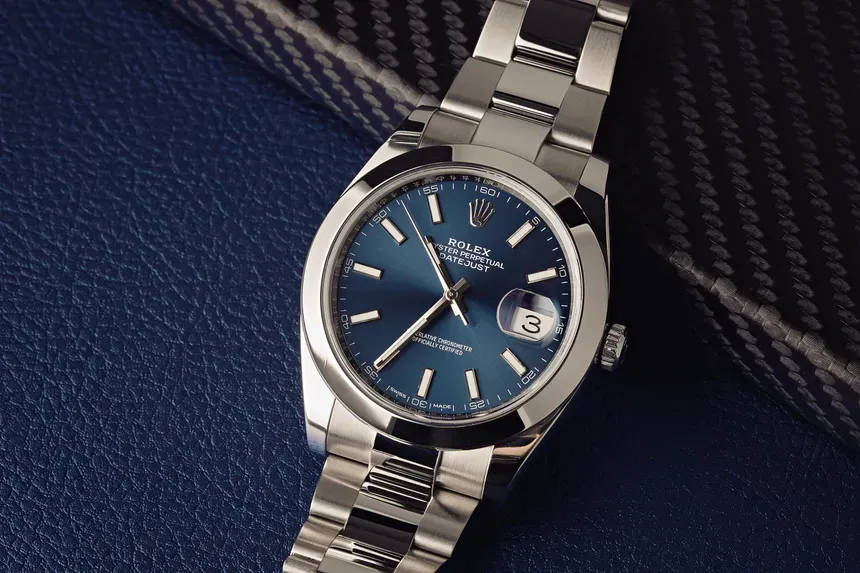
On paper, the Datejust is a simple watch. Three hands, a date window, a bezel. No chronograph pushers, no GMT hand, no helium escape valve. But simple doesn’t mean easy.
The Datejust has been in production since 1945. Rolex has refined every millimeter of it over eight decades. The fluted bezel alone has its own visual language. The Jubilee bracelet has a specific drape. The cyclops has a precise magnification. Get any of these wrong and the watch reads as off, even to someone who doesn’t know why.
This is why the Datejust is a genuine test for any super clone. The tells aren’t hidden in the movement—they’re right on the wrist, in plain sight.
The Fluted Bezel Problem
Start here. The fluted bezel is the Datejust’s signature. On a genuine steel Datejust, that bezel is 18k white gold. Not plated. Not steel. Solid precious metal.
That matters for two reasons.
First, white gold has a slightly warmer tint than stainless steel. Put them side by side and you’ll see it—steel is cooler, whiter; white gold has a faint yellowish cast. Most super clones use steel for the bezel because it’s cheaper and easier to work. The color difference is subtle but it’s there.
Second, white gold is denser than steel. A genuine fluted bezel has a specific heft. Pick up a steel rep and a gen Datejust and the weight difference at the bezel is noticeable, even if the overall watch weight is close.
The shape of the fluting itself is another tell. Genuine Rolex fluting has a precise depth and angle that catches light in a particular way. It’s not just decorative—the fluting was originally designed to help grip the bezel for tightening. On a super clone, the fluting is often shallower or the edges are less crisp.
VSF’s current bezel is considered better than it used to be—on par with GMF and ahead of QF or ARF. But it’s still not white gold. If you’re looking at a super clone Datejust and the bezel doesn’t have that warm metallic sheen in natural light, that’s your first red flag.
Dial Color and Text Placement
The dial is where a lot of super clones fall short. Not because the color is wrong—modern reps are good at matching paint. The issue is the details.
Text placement. On a genuine Datejust, the text at 6 o’clock—”SUPERLATIVE CHRONOMETER OFFICIALLY CERTIFIED”—is perfectly aligned, with consistent letter spacing and depth. Under a loupe, the printing is crisp. On a rep, the text can be slightly fuzzy, or the spacing can be off, or the font weight doesn’t quite match.
The laser-etched crown. Rolex started adding a tiny crown logo at 6 o’clock on the crystal in the early 2000s as an anti-counterfeiting measure. On a genuine watch, it’s nearly invisible to the naked eye—you need a loupe or a specific light angle to see it. On many super clones, it’s either too visible or completely missing. VSF’s version is faint, which is closer to gen, but the microtext inside the crown is where the real tells live. Genuine Rolex laser-etching is incredibly fine; rep etching is often slightly thicker or less precise.
Lume. Rolex uses a specific lume material (Chromalight) that glows blue and has a consistent color temperature across all indices. On a super clone, the lume can be uneven, or the color can lean green under UV light. The application itself can be lumpy or inconsistent between indices.
The cyclops and date wheel. The genuine Datejust cyclops magnifies the date by 2.5x. That’s a specific optical property. Many super clones get the magnification wrong—either too weak or too strong. The date wheel itself is another giveaway. On a genuine Rolex, the date sits centered in the window. On a rep, the date can be slightly high, slightly low, or slightly left/right. VSF’s date wheel alignment is generally good, but it’s worth checking each date—some numbers sit better than others.
Jubilee Bracelet Fit
The Jubilee bracelet is a five-link design with a specific flexibility and drape. On a genuine Rolex, the links move smoothly and the bracelet wraps around the wrist without gaps.
The biggest tell on a super clone Jubilee is the SEL—Solid End Link. That’s the piece where the bracelet meets the case. On a genuine Datejust, the SEL fits flush against the lugs with no gap. On a rep, you often see a small gap between the SEL and the case.
Some gap is acceptable on a replica—perfect SEL fit is genuinely hard to achieve. But if you can see light through the gap, or if the gap is visible from arm’s length, that’s a problem. On the Jubilee bracelet, SEL gaps are less obvious than on an Oyster bracelet, but they’re still a tell.
The clasp is another area. Genuine Rolex clasps have a crisp action and a solid feel. On a super clone , the clasp can feel slightly cheap or the mechanism can be less smooth. This is one of those things you only notice when you handle the watch, but it’s real.
The Verdict on Datejust Clones
The Datejust super clone market is dominated by VSF. With Clean Factory closed after the July 2025 raid, VSF is the current default for top-tier Rolex reps. Their Datejust uses 904L steel, a sapphire crystal with AR coating, a ceramic bezel insert, and a VS3235 clone movement that beats at 28,800bph with a 72-hour power reserve.
But even the best super clone has tells.
The fluted bezel is steel, not white gold. The SEL fit isn’t perfect. The lume isn’t quite right under UV. The movement finishing under a display back won’t match a genuine Rolex. And there’s no resale market, no Rolex warranty, and no water resistance that matches Rolex’s pressure testing.
None of this means a super clone Datejust is a bad watch. It means it’s a replica, and it has limits. The trick is knowing what those limits are before you buy, not after.
Where to Actually Start Looking
If you’re in the market for a Datejust super clone, the first question isn’t “which factory?” It’s “who’s selling it?”
The replica rolex market doesn’t work like regular retail. There’s no Amazon, no storefront with a return policy. The good dealers operate through forums, messaging apps, and community-vetted lists. The bad ones operate the same way, but they take your money and send you a lower-tier watch—or nothing at all.
Here’s what separates a good dealer from a bad one.
Factory sourcing. A good dealer tells you which factory made the watch. VSF, Clean (before the raid), GMF, ARF—these names mean something. A bad dealer calls everything “1:1 Swiss quality” and won’t name a factory. If they can’t tell you where the watch came from, they’re not sourcing from the top tier.
QC photos. Quality control photos are standard practice in the replica community. The dealer sends you photos of the actual watch you’re getting—not a stock photo, not a factory promo shot. You check the alignment, the date wheel, the SEL gaps, the bezel. If something’s off, you can reject it and ask for another. A dealer who doesn’t offer QC photos is a dealer to avoid.
Movement transparency. The VS3235 is the gold standard for Datejust clones right now—72-hour power reserve, 28,800bph, and a construction that mimics the genuine Rolex 3235. Some dealers will try to pass off a lower-tier movement as a VS3235. If they can’t tell you the movement caliber, or if they’re vague about it, that’s a problem.
Community reputation. The replica community is small and vocal. If a dealer has been around for a few years and has positive feedback on forums like RWI or RepGeek, that’s a good sign. If they’re new and have no track record, proceed with caution.
One VSF-focused dealer that consistently comes up in community discussions is Super Clone Rolexes—they specialize in the VS3235 Datejust and other top-tier models. Their inventory is worth a look if you’re serious about a Datejust super clone.
The bottom line: don’t buy from the first site you find. Do your homework. Ask questions. If a deal feels too good to be true, it is. The super clone market is full of genuine quality—but it’s also full of people who will sell you a $50 watch for $500 and call it a day.
Note: This article is for educational and informational purposes only. The purchase and import of counterfeit goods may violate trademark laws in your jurisdiction. Check your local laws before buying.